
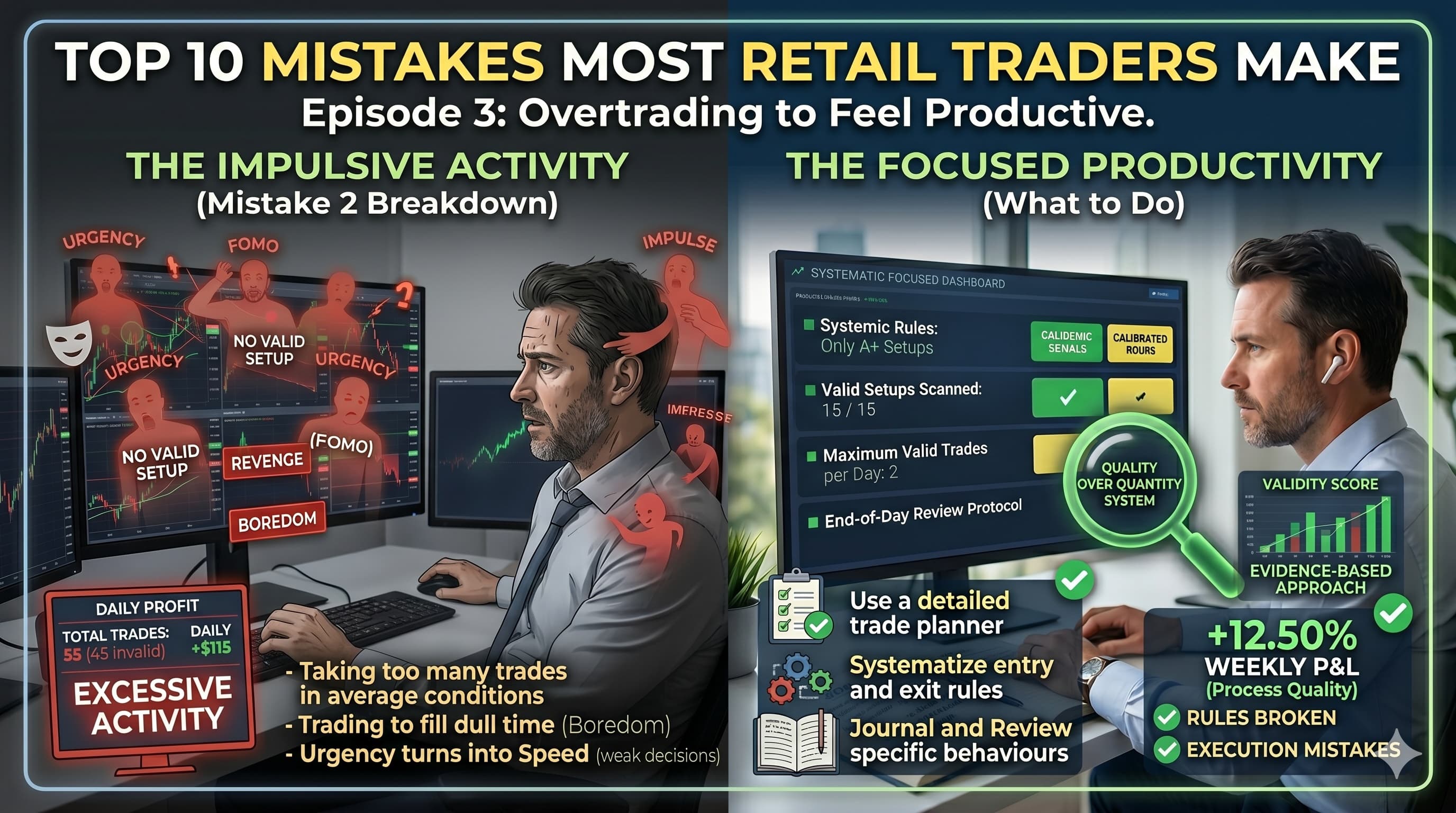
Top 10 Mistakes Most Retail Traders Make (Episode 3): Overtrading to Feel Productive
Top 10 Mistakes Most Retail Traders Make (Episode 3): Overtrading to Feel Productive
Overtrading is one of the most common retail trading mistakes because it is so easy to justify.
It does not usually feel reckless.
It feels active. Committed. Hardworking.
That is why traders fall into it so easily.
Why activity feels like progress
When you spend hours at the screen, it is natural to want output from that time.
So the mind starts making quiet assumptions:
- more trades means more learning
- more trades means more chances
- more trades means I am engaged and improving
But none of those are automatically true.
More trades often just means more exposure to average conditions, weaker decisions, and emotional fatigue.
What overtrading usually looks like
It is not always obvious.
Sometimes it shows up as:
- taking second and third trades in conditions where the first one already told you enough
- re-entering quickly because you do not want to miss a move
- trading multiple instruments simply because one market is quiet
- lowering the quality threshold as the session goes on
- treating every decent-looking pattern as an opportunity
In other words, overtrading is often not one bad decision.
It is a steady loss of selectivity.
Why retail traders do it
Usually for understandable reasons.
They want more experience. They want to recover losses. They want to make the day feel worthwhile. They assume staying busy is part of taking trading seriously.
Sometimes boredom is involved. Sometimes pressure is involved. Sometimes confidence is involved.
But underneath it all is the same issue:
the trader starts valuing participation more than edge.
What this mistake costs
The financial cost is obvious enough.
The deeper cost is that overtrading makes your own data harder to trust.
If your real edge appears in a narrow slice of your trades, but you keep adding many average or weak ones around it, your results get blurred.
Now it is harder to tell:
- whether the strategy is working
- whether your best conditions are actually profitable
- whether the real issue is quality or simply too much volume
That lack of clarity slows improvement far more than most traders realise.
How to work on it
A few useful steps:
- define what a valid setup must include before the session starts
- limit the hours you are allowed to trade
- track how your first trade, first two trades, and later trades compare
- review whether lower-quality trades cluster in certain emotional states
- remember that more trades do not make a weak day productive
Many traders reduce overtrading once they see how much better their first trade or first two trades perform compared with the rest.
That evidence matters.
It turns the issue from a general discipline problem into a measurable one.
Selectivity is not passivity
Retail traders often worry that being more selective will make them too cautious.
Usually the opposite happens.
When the threshold is clear, execution becomes sharper because you are no longer draining attention on every almost-valid opportunity.
You trade less, but the trades you do take make more sense.
That is not hesitation.
That is precision.
Final thought
Overtrading survives because it looks productive from the outside.
But trading is not paid by effort alone.
It is paid by quality, timing, and control.
If you keep taking more trades than your edge really supports, you are not giving yourself more opportunity.
You are diluting the few moments that were actually worth acting on.