
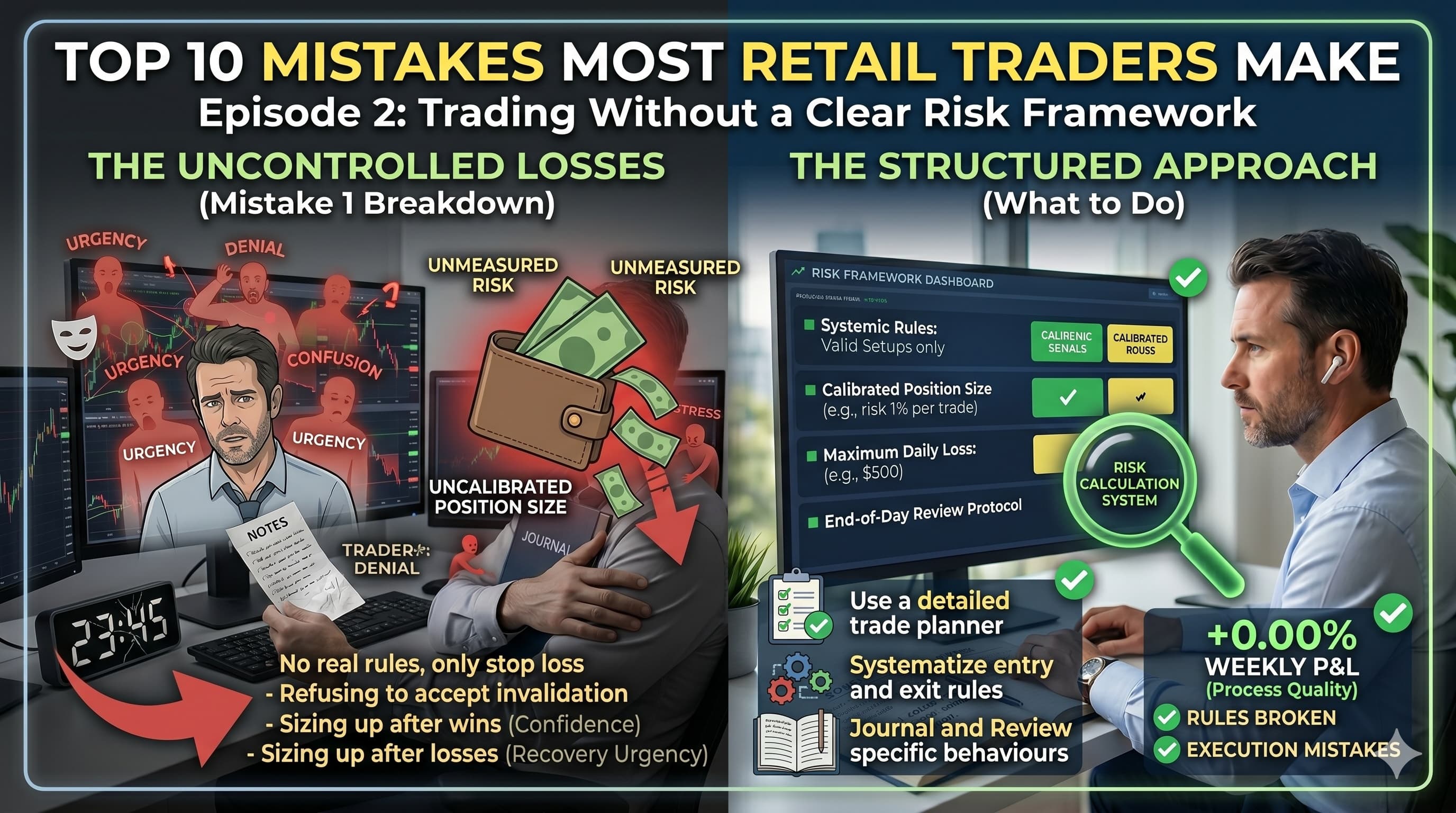
Top 10 Mistakes Most Retail Traders Make (Episode 2): Trading Without a Clear Risk Framework
Top 10 Mistakes Most Retail Traders Make (Episode 2): Trading Without a Clear Risk Framework
Many retail traders believe they manage risk because they use a stop loss.
That is a start.
It is not a framework.
A stop tells you where one trade should fail. A risk framework tells you how risk is handled across the whole decision process.
Without that broader structure, discipline becomes highly vulnerable to mood, confidence, and recent results.
What a real risk framework includes
At minimum, it should answer questions like:
- how much do I risk per trade?
- what is my maximum loss for the day?
- when do I reduce size?
- how much exposure can I carry across positions?
- what behaviour means I should stop trading?
If those answers are unclear, then risk is still partly discretionary.
That may feel flexible, but under pressure it usually means emotional decisions fill the gaps.
Why this mistake is so common
Because vague risk feels easier than explicit risk.
A trader can say:
- "I usually risk small."
- "I do not let losses get out of hand."
- "I know when to stop."
Those statements sound responsible.
But they are not precise enough to protect behaviour when the day gets emotional.
What counts as small? What counts as out of hand? When exactly is it time to stop?
If the answer changes with mood, then the rule is not strong enough yet.
What this mistake costs
The cost is not just bigger losses.
It also creates:
- inconsistent position size
- poor recovery behaviour after red sessions
- uncertainty about whether you are actually following your own rules
- weak feedback, because you cannot tell whether the problem was the trade or the risk process
This is one reason decent traders can still feel unstable for a long time.
Their entries may not be terrible.
But the framework around those entries is too loose to produce repeatable outcomes.
A minimum viable risk framework
It does not need to be complicated.
For many traders, a useful starting point is:
- one fixed percentage or fixed cash amount per trade
- one daily loss limit
- one rule for reducing size after a losing sequence
- one rule for stopping after emotional rule breaks
That alone is much stronger than relying on instinct.
The point is not to create an elaborate document.
The point is to remove ambiguity from the exact places where emotion usually enters.
How to work on it
Start by writing your current answers down.
If the answers sound vague when written, they are probably too vague in practice as well.
Then tighten them.
Turn:
- "I risk small"
into:
- "I risk 0.5 percent per trade"
Turn:
- "I stop when I feel off"
into:
- "I stop after two rule-breaking trades or after hitting my daily loss limit"
The clearer the language, the less room emotion has to reinterpret it.
Why this mistake matters so much
Retail traders often focus on finding better setups before they build better boundaries.
That sequence causes problems.
Even a decent edge becomes hard to express if the risk around it keeps changing.
A clean setup taken with unstable size, unclear limits, and emotional exceptions does not stay clean for long.
Final thought
Trading without a clear risk framework does not always look reckless.
Often it looks normal.
That is what makes it dangerous.
The trader feels responsible because they have some rules, but the rules are not specific enough to survive pressure.
If you want more consistency, one of the strongest moves you can make is to stop treating risk as a general principle and start treating it as a defined operating system.