Why Boredom Creates Some of the Worst Trades
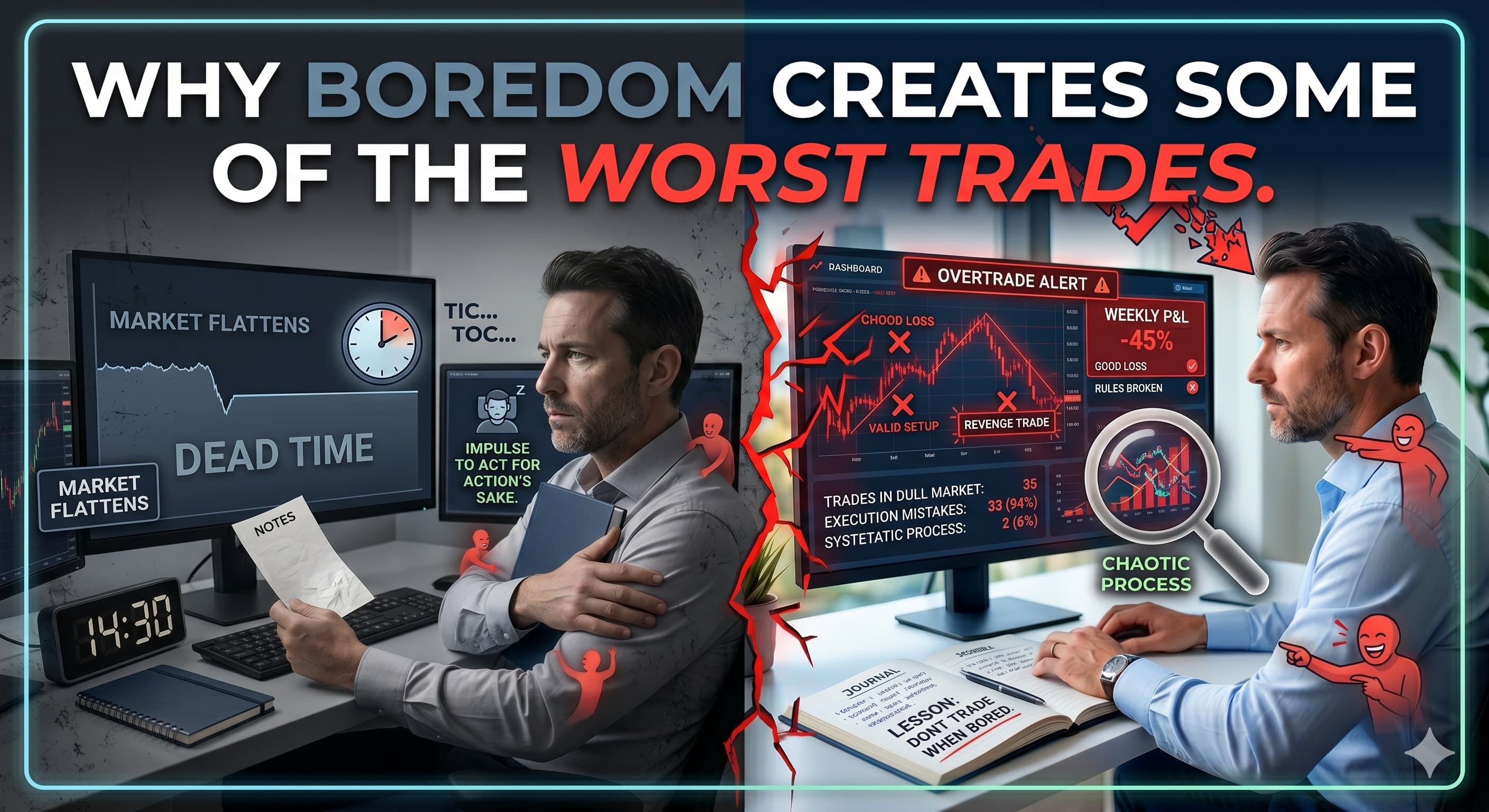
Why Boredom Creates Some of the Worst Trades
When traders think about emotional mistakes, they usually think about fear, greed, or revenge.
Boredom gets much less attention.
That is a mistake.
Because boredom is behind a surprising number of poor trades.
Not dramatic trades. Not reckless all-in decisions.
Just low-quality entries taken because the market is quiet, attention is fading, and doing nothing starts to feel uncomfortable.
Quiet markets test discipline differently
Fast markets make mistakes obvious.
You can feel the urgency, the pressure, the emotional spike.
Quiet markets are trickier.
They do not overwhelm you. They slowly wear you down.
You sit. You wait. Nothing fully forms. The moves are partial. The structure is weak. The market does not offer a clean reason to act.
At first that is manageable.
After an hour or two, it starts to create pressure of a different kind.
You do not want excitement exactly. You just want resolution.
And that is where bad trades begin.
Boredom lowers standards gradually
This is the real danger.
When boredom takes over, most traders do not suddenly decide to abandon their plan.
They just become slightly more flexible.
The setup that was not quite there ten minutes ago now looks acceptable. The level that was messy now looks tradable. The entry that needed confirmation now feels close enough.
Nothing feels obviously reckless.
That is why boredom-driven mistakes are easy to miss in the moment.
They feel reasonable because the change in standards happens one small step at a time.
Why boredom is so hard to respect
There are a few reasons traders underestimate it.
First, boredom does not feel emotional. It feels harmless.
Second, doing nothing can feel unproductive, especially if you have set aside time specifically to trade.
Third, many traders still have an unspoken belief that good traders should always be able to find something.
That belief creates damage.
There are many sessions where the professional move is not to find something.
It is to recognise that nothing clear is there and protect your decision quality by staying out.
Signs you are trading boredom rather than edge
This pattern often shows up in a few familiar ways:
- dropping to lower timeframes just to create activity
- taking setups that are "almost" valid
- switching instruments repeatedly because nothing is moving enough
- entering without the same patience you had earlier in the session
- feeling relief simply because you are finally in a trade
That last one is especially revealing.
If the main emotional benefit of the trade is that it ends the boredom, the trade probably should not exist.
What to do about it
The answer is rarely more willpower.
It is structure again.
Useful ways to reduce boredom trading include:
- trading only during a defined window rather than watching all day
- identifying in advance what must be present before you can act
- limiting how often you can switch instruments or timeframes
- stepping away physically when conditions are dead
- reviewing how many losing trades came from marginal setups in quiet periods
A lot of traders improve simply by shortening exposure to low-opportunity time.
They do not become more disciplined through effort alone.
They become more disciplined because they spend less time sitting in the exact conditions that trigger weak decisions.
Boredom is not neutral
This is worth remembering.
Boredom is not just the absence of opportunity. It is a decision environment.
And for many traders, it is a bad one.
That is why the quiet part of the session deserves as much respect as the volatile part.
The market does not need to be dramatic for it to be dangerous.
Sometimes the most expensive state is simply sitting there long enough to want action more than quality.
Final thought
Some of the worst trades are taken not because the trader was highly emotional, but because they slowly became willing to trade anything that looked close enough.
Boredom is powerful for that reason.
It changes behaviour without announcing itself.
If you want cleaner execution, do not just study how you behave when the market is fast.
Study how you behave when the market is dull, your attention starts drifting, and the urge to make something happen begins to grow.
That is where a lot of unnecessary trades are born.