
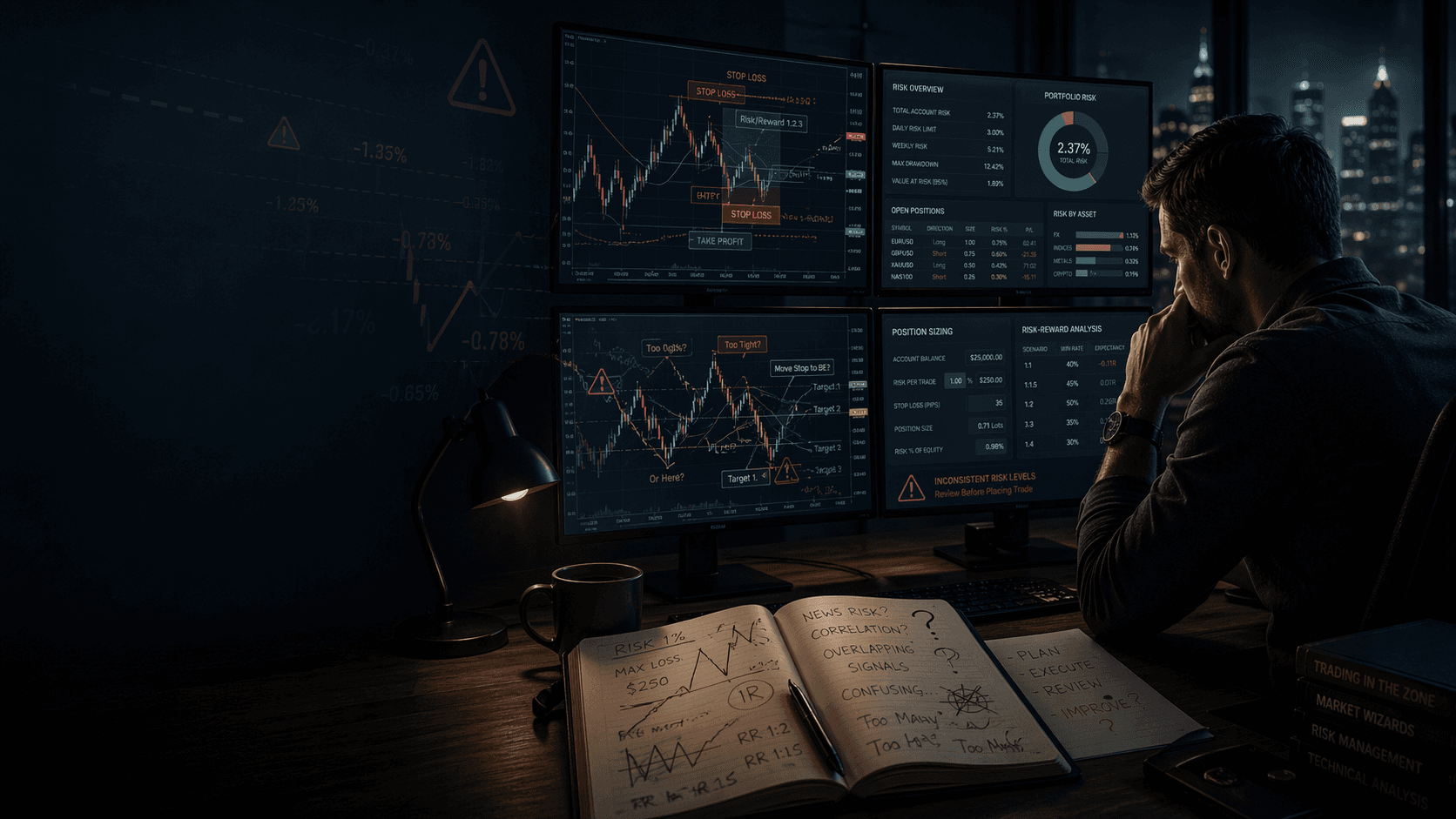
Your Risk Management Is Probably Less Clear Than You Think
Your Risk Management Is Probably Less Clear Than You Think
Ask most traders whether they manage risk, and many will say yes immediately.
They will say things like:
- "I always use a stop."
- "I never risk too much."
- "I know my max loss."
- "Risk management is one of my strengths."
Sometimes that is true.
But quite often, risk management sounds clearer in theory than it actually is in practice.
And that gap matters far more than traders realise.
Risk management is not just having a stop loss
This is one of the most common misunderstandings.
Using a stop is important, but it is only one part of risk management.
Real risk management also includes:
- how much you risk per trade
- when you reduce size
- when you stop for the day
- how you respond after a losing streak
- whether your trade size changes emotionally
- how much total exposure you carry across positions
- whether you trade differently in different conditions
A trader can use stops and still manage risk poorly.
Vague rules do not survive pressure
Many traders believe they have rules, but those rules are too loose to be reliable.
For example:
- "I do not risk too much."
- "I cut trades if they look wrong."
- "I stop when I feel off."
- "I size down when needed."
The problem is obvious in live markets.
What counts as too much?
What does "look wrong" actually mean?
How do you measure feeling off?
When exactly is size reduction needed?
When the rules are vague, emotion fills the gap.
And emotion under pressure is rarely a strong risk manager.
Good risk management should be boringly clear
A useful risk rule is one that is hard to misinterpret.
Examples include:
- "I risk 0.5% per trade."
- "After two losses, I reduce risk by half."
- "My daily loss limit is 1.5%."
- "I do not open new positions after hitting max daily drawdown."
- "I do not hold beyond my stop under any condition."
- "I do not add to losers."
These kinds of rules reduce decision-making under stress.
That is the point.
Risk management works best when it removes room for negotiation.
Traders often discover risk problems too late
A common pattern looks like this:
A trader feels fine while things are going well.
Then the market becomes difficult.
Losses cluster.
Confidence drops.
Urgency rises.
Suddenly, their risk behaviour changes.
They:
- increase size to recover faster
- take lower-quality trades
- widen stops
- re-enter too quickly
- ignore session limits
- keep trading because they do not want to end red
At that moment, the biggest risk is not the market.
It is the trader's changing behaviour.
Risk management is also emotional management
This is often overlooked.
Many so-called risk failures are not mathematical failures. They are emotional failures.
The trader knew the number.
They ignored it because of frustration, fear, or overconfidence.
That is why risk plans must account for behaviour, not just percentages.
You need rules not only for normal conditions, but for the moments where you are most likely to abandon them.
A strong strategy can still fail with weak risk control
This is why some traders stay stuck even when they have genuine edge.
Their entries may be decent.
Their market understanding may be strong.
Their analysis may be better than average.
But poor risk behaviour keeps damaging the outcome.
One oversized loss can erase several well-executed trades.
One impulsive session can distort a strong week.
One lapse in discipline can make the statistics of a good strategy look far worse than they really are.
That is why risk management is not a side issue.
It is part of the strategy.
A useful way to test your clarity
Ask yourself these questions:
- What is my exact per-trade risk?
- What is my daily stop?
- What changes after two losses?
- What changes after a big win?
- What behaviour is completely forbidden?
- Under what conditions do I stop trading for the session?
- Do I have rules for size, frequency, and total exposure?
If you cannot answer those clearly and quickly, your risk framework may be less defined than you think.
Why traders avoid tightening risk rules
Usually because tighter rules can feel restrictive.
They can make traders worry that they will:
- miss opportunities
- make less money
- recover losses more slowly
- feel less flexible
- lose their edge in fast conditions
But in reality, unclear risk rules usually cost far more than tight ones.
Freedom without structure sounds attractive until emotions take over.
Final thought
Most traders do not ignore risk management completely.
The bigger issue is that their rules are often too vague, too flexible, or too easy to abandon when pressure rises.
That is where the damage happens.
Clear risk management is not just about protecting capital.
It protects judgement.
It protects consistency.
It protects the ability to come back tomorrow with control still intact.
And in trading, that matters more than many people realise.